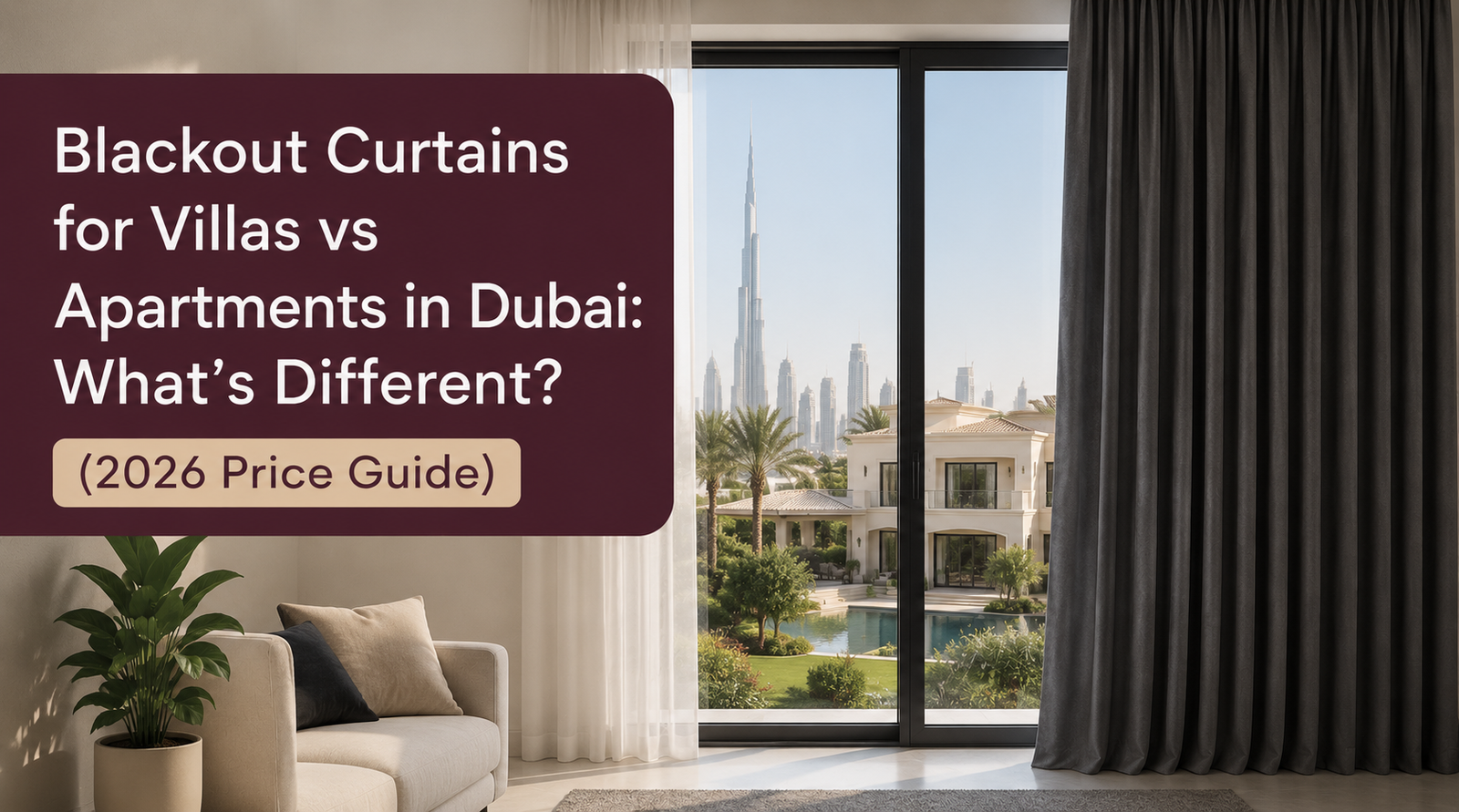
The same blackout curtain fabric can perform completely differently depending on whether it’s hanging in a Marina apartment or an Arabian Ranches villa. It’s not just about square footage — window height, ceiling type, sun exposure, and even the building’s structure all change what “the right curtain” actually means.
Here’s a proper breakdown of where villas and apartments differ, and what that means for the curtains themselves.
The Core Difference: Window Type, Not Just Size
Apartments in towers across Downtown, Marina, JBR, and Business Bay are overwhelmingly built around floor-to-ceiling glass, often spanning an entire wall. When choosing blackout curtains dubai, this layout demands a completely different approach compared to villas in communities like Arabian Ranches or Dubai Hills., Mirdif, and Jumeirah — tend to have standard framed windows, sometimes with a recess, sometimes bay-shaped, and generally smaller relative to the room than a tower’s glass wall.
That single structural difference cascades into almost every other decision below.
Mounting: Ceiling Track vs Wall Track
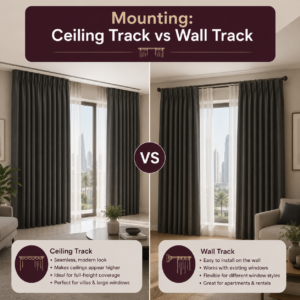
Apartments with floor-to-ceiling glass usually have little to no wall space above the window to fix an outside-mount track. This pushes most tower apartments toward ceiling-mounted S-fold tracks, which run directly along the ceiling line and give a clean, tailored look against full-height glass. Many newer towers even have a recessed ceiling channel built in specifically for this.
Villas typically have standard wall space above the window frame, making outside-mount tracks or rods the more common and simpler option. Because villa windows are usually smaller and more numerous per room (rather than one dominant glass wall), each window often gets its own track rather than one continuous ceiling run.
Fabric Weight and Motorization
Apartments with large glass walls often benefit from motorized tracks, simply because manually pulling a curtain across 4-5 meters of S-fold fabric daily gets impractical fast. Lighter or medium-weight fabrics (like triple-weave polyester) are common here, partly for heat performance and partly because they’re easier on a motor than heavier velvet.
Villas have more flexibility. Smaller, individual windows mean manual rods or tracks are often perfectly practical, so heavier fabrics like velvet are used more often in villa living rooms and bedrooms — the weight and drape suit the room’s proportions and formal styling without needing a motor to manage day-to-day use.
Heat and Sun Exposure
Apartments, especially in glass towers, face more concentrated and prolonged heat exposure. A west-facing Marina apartment can turn into a greenhouse by mid-afternoon, since there’s rarely any external shading structure — just glass directly facing the sun. This usually pushes the fabric decision toward thermal-lined polyester or heavier velvet with strong insulating properties.
Villas often have some natural shading — overhangs, neighboring walls, garden trees, or simply smaller windows that don’t span an entire wall. Heat exposure tends to be less extreme per window, though it varies more room-to-room depending on the villa’s orientation and layout.
Number and Variety of Windows
Apartments usually have a limited number of large windows — often one or two per room. This actually simplifies planning, since there’s less variety to account for.
Villas tend to have more windows overall, often in different shapes and sizes across the same room. This variety means villa installations usually need more on-site planning. We provide expert consultation across all service areas in Dubai to decide track types, fabric drops, and mounting options room by room.
Installation Complexity
Apartments usually mean working within building management rules — some towers restrict drilling into ceilings or require approval for track curtains installation, especially in rented units. No-drill track options are more commonly requested here for exactly this reason.
Villas, being privately owned structures, generally have fewer restrictions on drilling or track placement, but the larger property means more rooms to plan across in a single visit, and sometimes higher ceilings that need a taller ladder or more careful track alignment.
Quick Comparison
| Factor | Apartments | Villas |
|---|---|---|
| Common window type | Floor-to-ceiling glass | Standard framed windows |
| Typical mounting | Ceiling S-fold track | Outside-mount wall track/rod |
| Fabric trend | Lighter, thermal-lined polyester | Heavier velvet common |
| Motorization | Common, often necessary | Optional, less essential |
| Heat exposure | High, concentrated | Moderate, varies by room |
| Installation restrictions | Building rules may apply | Generally fewer restrictions |
| Windows per room | Fewer, larger | More, varied shapes/sizes |
What This Means for Your Order
If you’re in an apartment, the decisions mostly center on one big glass wall — get the ceiling track and fabric weight right, and most of the planning is done. If you’re in a villa, the decisions are more about coordinating several windows across a room or the whole property, which is why villa measurement visits often take longer per property even though each individual window might be simpler.
Frequently Asked Questions
Do apartments always need motorized curtains? No, but it’s common for practical reasons. Manual S-fold curtains on a wide ceiling track can be pulled by hand, but the fabric bunches unevenly over time without a motor helping distribute the fold. It’s not mandatory, just noticeably more convenient on larger glass walls.
Can villa windows use ceiling-mounted S-fold tracks too? Yes, especially in modern villas with double-height living rooms or large sliding doors leading to a garden or pool area. It’s less common than in apartments simply because villa windows are more often a standard wall-mounted shape.
Is velvet impractical for apartments? Not impractical, just less common. Velvet works fine in an apartment bedroom or a smaller window, but on a full floor-to-ceiling glass wall, the weight and cost scale up quickly, which is why lighter fabrics are the more typical choice for that specific window type.
Why do villa installations sometimes take longer than apartment ones? It’s rarely about difficulty per window — it’s the number of windows and rooms involved. A villa measurement visit might cover eight or nine windows across different rooms, each with its own mounting and fullness decision, versus an apartment visit that might only involve two or three larger windows.
Do rented apartments have restrictions on installing curtain tracks? Sometimes, depending on the building’s management rules — particularly around ceiling drilling for S-fold tracks. No-drill or adhesive-mounted track options exist specifically for renters who can’t make permanent changes to the ceiling or walls.
Which is more expensive to furnish with blackout curtains — a villa or an apartment? It depends more on total window area and fabric choice than property type alone. A villa with many windows can cost more overall simply due to volume, even if each individual curtain is cheaper than a single wide apartment glass-wall curtain.
Not Sure Which Setup Fits Your Home?
Every property is different enough that the right mounting, fabric, and track type is best confirmed on-site. Book a free measurement visit and we’ll walk your space — villa or apartment — and recommend what actually fits your windows.