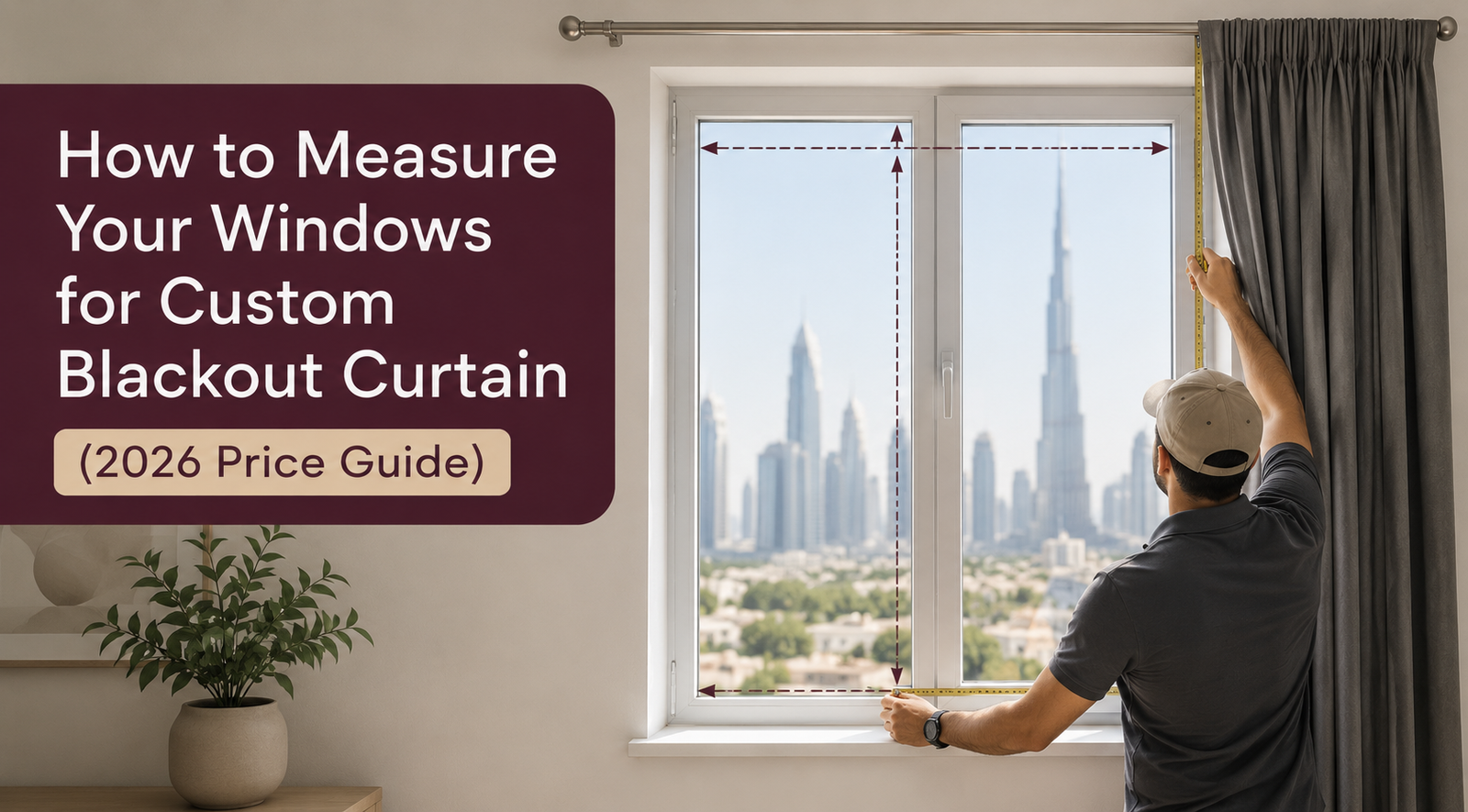
A curtain that’s even 5cm off can ruin the whole point of “blackout” — light leaks in at the edges, the fabric doesn’t sit right on the track, and you’re left re-ordering. Measuring correctly the first time saves both the fabric cost and the wait for a remake.
This matters more in Dubai than in most places. Floor-to-ceiling glass in Downtown and Marina towers, oversized villa windows in Arabian Ranches and Dubai Hills, and the sheer intensity of the sun here mean a small measuring error shows up fast — as a bright strip of light across the ceiling at 5am, or a curtain that never quite closes flush. Standard “off-the-shelf” curtain sizing rarely matches these window types anyway, which is exactly why custom measuring exists.
Here’s exactly how to do it properly, whether you’re measuring for a simple rod, a track, or a motorized S-fold system — plus the mistakes that cause most of the light-leak complaints we see.
Why Blackout Curtains Are Less Forgiving Than Regular Curtains
Regular curtains are decorative first — a centimeter of slack here or there barely shows. Blackout curtains have one job: block 100% of light. That means every gap, every inch of fabric that doesn’t overlap the frame, and every bit of missing fullness becomes visible the moment the sun hits it. A regular curtain measured slightly wrong still looks fine. A blackout curtain measured slightly wrong stops doing the one thing you bought it for.
This is why professional installers obsess over three things most people skip: the side extension beyond the frame, the fullness ratio, and the mounting type — all covered in detail below.
What You’ll Need
- A steel measuring tape (not fabric or laser — steel gives the most accurate rigid measurement)
- A notepad or your phone to record numbers immediately
- A second person to hold the tape steady on wider windows
- A ladder, if your window or track sits above easy reach

Step 1: Decide on Mounting Type First
Before any measurement matters, decide how the curtain will hang, because it changes every number after this. This is the step most people rush through, and it’s the one that determines whether the curtain will actually block light or just look like it does.
Inside mount The curtain sits inside the window recess, flush with the frame. It gives a neat, built-in look and works well when you don’t want the curtain to interrupt wall space or window trim.
- Needs at least 10cm of recess depth to work properly.
- Almost always leaves small light gaps on the sides and top, since the fabric can’t extend past the frame.
- Rarely the right choice if blocking light is the main priority — it’s more of a style choice for daytime rooms.
Outside mount The track or rod is fixed to the wall above and beyond the window frame, rather than inside it. This is the standard choice for blackout curtains dubai specifically.
- Eliminates most side light gaps because the fabric extends well past the glass on both sides.
- Makes the window look larger, since the track spans more wall than just the frame.
- Needs enough flat wall space on either side of the window — worth checking if you have wall art, switches, or shelving nearby.
Ceiling mount / S-fold track The track is fixed directly to the ceiling rather than the wall, common in villas and apartments with floor-to-ceiling glass across Downtown, Marina, and Business Bay towers.
- Best option for full-height glass where there’s no wall space above the window to mount an outside track.
- Gives the cleanest, most tailored look, especially with motorized S-fold systems.
- Requires the ceiling structure to support the track weight, which matters more for heavier fabrics like velvet.
For genuine blackout performance, outside mount or ceiling mount is almost always the better choice — inside mount tends to leave light gaps along the edges no matter how precise the fabric cut is. If you’re unsure which applies to your window, this is usually the first thing decided during a measurement visit, before any tape measure comes out.
Step 2: Measure the Width
- Decide where your track or rod will actually be installed — not the window frame width, the track width.
- For outside mount, extend the track 15–20cm beyond the window frame on each side. This is what lets the curtain fully clear the glass when opened, and blocks light from sneaking in at the edges when closed.
- Measure the full width of that planned track, wall to wall.
- Multiply by a fullness factor of 2 to 2.5x for the actual fabric width — blackout curtains need generous fullness to close without gaps. A 2m track typically needs 4–5m of fabric across the panel(s).
Step 3: Measure the Drop (Height)
- Measure from where the track or rod will sit down to your desired finish point.
- Common finish points:
- Sill length — just below the windowsill, common for kitchens or smaller rooms.
- Floor length (floating) — 1–2cm above the floor, the standard choice for most bedrooms curtains and living rooms.
- Floor length (kissing the floor) — fabric just touches the floor, popular for a more tailored look.
- Puddle length — extra fabric pools on the floor, mostly a formal/decorative choice rather than a practical blackout one.
- For ceiling-mounted S-fold tracks, measure from the ceiling fixing point straight down, since this is the number that determines total fabric drop.
Step 4: Check Recess Depth (Inside Mount Only)
If you’re set on an inside mount despite the light-gap trade-off, measure the depth of the recess from the front of the frame to the glass. You need at least 10cm of usable depth for the track or rod to sit without touching the glass or obstructing the window opening.
Step 5: Note Obstructions
Walk the width of the window and note anything that could interfere with the track or curtain fall:
- AC vents or diffusers near the ceiling line
- Window handles or opening mechanisms that stick out
- Wall-mounted lights or shelving close to the frame
- Skirting or flooring transitions that affect the finish length
These don’t stop a measurement from being accurate, but they change where the track can physically go — which is why professional installers walk the wall before finalizing numbers, not just the window.
Measuring Different Window Types Common in Dubai Homes
Not every window follows the standard rectangle-and-wall setup, and Dubai’s mix of high-rise apartments and villas throws up a few recurring shapes worth knowing about before you start measuring.
Floor-to-ceiling glass (common in Downtown, Marina, Business Bay towers) There’s often no wall space above the glass to mount an outside track, which usually pushes the decision toward ceiling mount. Measure the full ceiling-to-floor drop, and check whether the ceiling has a bulkhead or recessed track channel already built in — many newer towers do, which changes how the track attaches.
Sliding balcony doors These need extra side extension beyond the standard 15–20cm, since the curtain has to clear the door track fully when it’s opened without bunching against the sliding mechanism. Measure the door in its fully open position, not just closed, to check the curtain won’t catch on the handle or frame.
Bay and arched windows Standard width-and-drop measuring doesn’t work cleanly here. Bay windows usually need a curved or angled track measured in individual segments rather than one straight width; arched windows often need the straight lower section measured separately from the curved top, since blackout fabric can’t follow a true arch without a custom-shaped track.
Double or triple window sets (common in villas) Where two or three windows sit close together with a narrow wall gap between them, it’s often better to treat them as one continuous track rather than separate curtains per window — otherwise the gaps between panels become light leak points exactly where you don’t want them.
Common Measuring Mistakes That Cause Light Leaks
- Measuring the window frame instead of the planned track position. These are rarely the same number for outside mount.
- Skipping the fullness multiplier. A curtain cut to the exact track width will always look and perform worse than one with proper fullness — it won’t close flat.
- Not accounting for the 15–20cm side extension. This single step is the biggest reason DIY blackout curtains still let light through at the edges.
- Measuring once and not double-checking. Walls in older buildings are rarely perfectly square — a width measured at the top of the window can differ by a centimeter or two from the bottom.
- Forgetting to measure in the door’s open position for sliding doors. A curtain measured only against the closed door can end up too short once the door track’s full clearance is accounted for.
- Using a fabric or cloth tape measure instead of steel. Fabric tapes stretch slightly over time and distance, which adds up on wider windows and throws off the final width.
DIY Measuring vs. a Free Measurement Visit
If you already have existing curtains that don’t fit quite right or need length adjustments, you can use our curtain repair and alteration service in Dubai instead of buying new ones., S-fold ceiling tracks, or rooms with obstructions like AC vents and uneven walls — all common in Dubai apartments and villas. A measurement visit removes that guesswork: the track position, fullness, and mounting type get decided on-site against your actual wall, not estimated from a tape measure and a hopeful multiplier.
Frequently Asked Questions
Do I measure before or after the curtain track is installed? Ideally before, so the track position itself is planned around the 15–20cm side extension. If a track is already installed, measure to that existing track rather than the window frame.
How much fabric fullness do blackout curtains actually need? Most blackout curtains need 2 to 2.5 times the track width in fabric. Less than that and the curtain won’t close flat, leaving gaps that let light through — which defeats the purpose of a blackout curtain specifically.
What if my window is an unusual shape, like an arch or a bay window? These need on-site measurement rather than a standard width-and-drop approach, since the track itself often has to be custom-shaped or split into angled sections to follow the window line.
Can I use the same measurements for motorized S-fold curtains? The width and drop principles are the same, but S-fold tracks have their own fullness ratio (typically around 2x rather than 2.5x) because the fold style itself adds visual fullness. It’s worth confirming this with whoever is supplying the motor and track.
How long does a free measurement visit usually take? For a standard apartment with a few windows, most visits take 20–30 minutes. Villas with multiple rooms or S-fold ceiling tracks can take longer since each track position needs to be planned individually.
What’s the biggest difference between measuring for blinds and measuring for blackout curtains? Blinds are typically measured to fit exactly within or just outside the frame, since they don’t rely on fullness or side overlap to work. Blackout curtains depend entirely on that extra width and side extension to close without gaps — a measurement approach that works fine for blinds will almost always leave light leaks if applied to blackout curtains.
Should I remeasure if I’m just replacing old curtains with new blackout ones on the same track? Yes, even if the track is staying the same. Old curtains were sized for their own fullness ratio and fabric type, which may not match what blackout fabric needs. It’s worth confirming the track width and drop again rather than assuming the old curtain’s dimensions will carry over correctly.
Skip the Guesswork
Getting measurements right the first time means no light leaks, no re-orders, and no fabric wasted. Book a free measurement visit and we’ll handle the track position, fullness, and mounting decisions on-site — accurate to your actual wall, not just a tape measure.