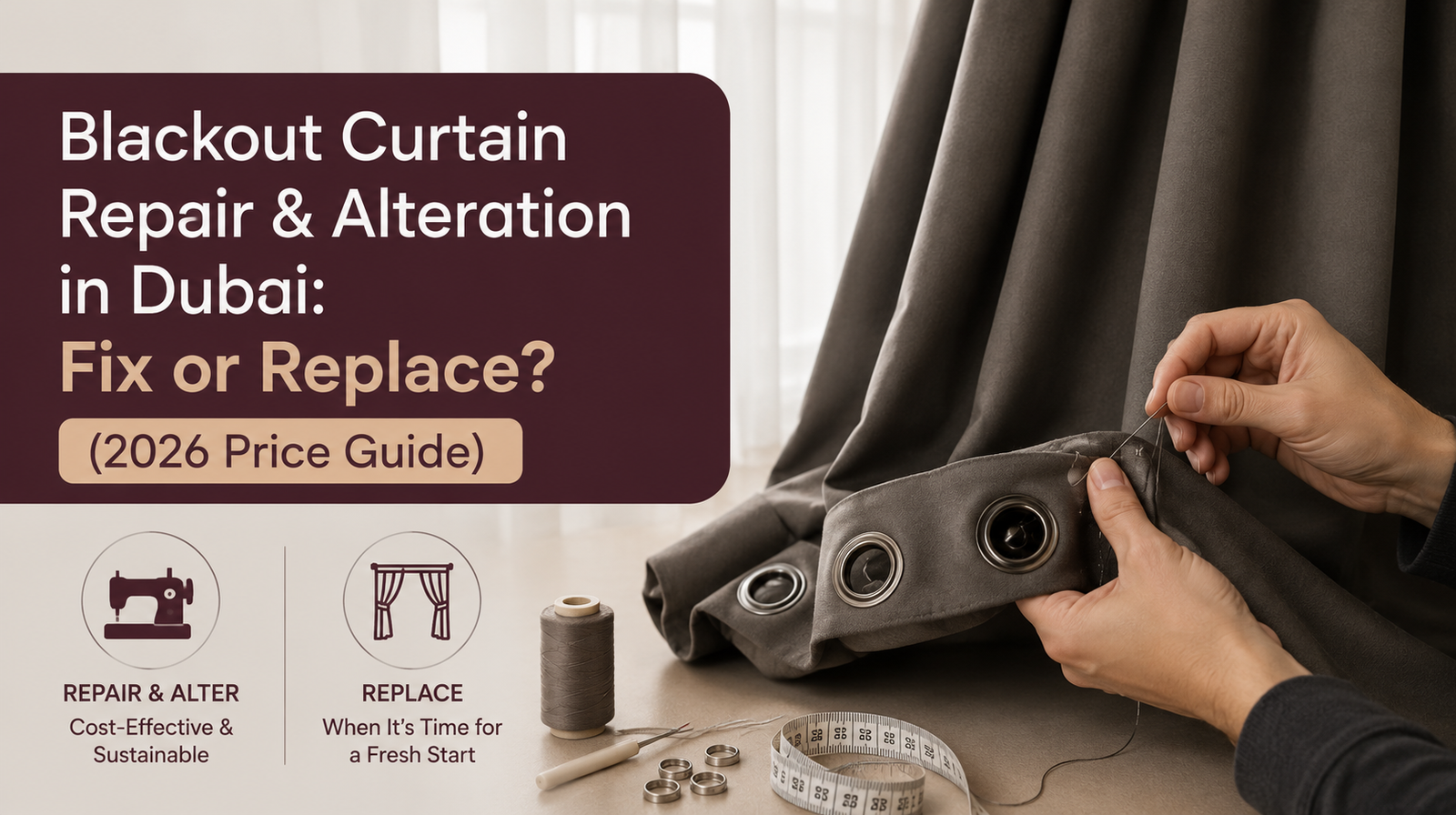
A jammed track, a fading fabric, a curtain that suddenly stops blocking light like it used to not every problem means buying new. This guide walks through what can be repaired, what’s worth altering, what genuinely calls for replacement, and roughly what each route costs in Dubai.
Repair or Replace? First, Identify What’s Wrong With Your Curtains
Most people jump straight to “should I just buy new curtains?” before actually diagnosing the problem. But a torn seam, a broken hook, and a curtain that’s lost its blackout effect entirely are three completely different situations and they call for three different decisions.
Before deciding anything, it helps to separate the issue into one of three buckets:
- Cosmetic or structural damage torn fabric, broken hooks, frayed hems, stuck tracks) usually repairable
- Fit or style mismatch too long, too wide, wrong pleat style, moved to a new home with different windows — usually an alteration job
- Performance failure light leaking through worn fabric, lining that’s degraded, fading that’s affected the blackout coating) — this is where replacement often makes more sense
Let’s go through each one properly.
Common Repairs — And What They Typically Cost
Torn or Frayed Fabric
Small tears, especially along seams or edges, can usually be professionally stitched without it being visible from a normal viewing distance. Larger tears in the middle of a panel are trickier — the patch may be noticeable unless it’s on a heavily textured fabric like velvet.
Broken Hooks, Rings, or Header Tape
This is one of the simplest and cheapest fixes there is. A curtain that’s stopped hanging evenly, or keeps dropping off the track, is very often just a hook or header tape issue, not a fabric problem at all.
Stuck or Noisy Tracks and Rods
If your curtain feels like it needs a shove every time you open it, the issue is almost always the track or rod, not the curtain itself. Cleaning, realigning, or replacing a worn track segment is usually far cheaper than anyone expects.
Motor Faults (Motorized Curtains)
When a motorized curtain stops responding to the remote or app, the fix depends on whether it’s a wiring issue, a dead motor unit, or a syncing problem with your smart home system. Motor repairs take a bit more diagnostic time but are still typically far cheaper than replacing an entire motorized track system.
Worn Lining or Reduced Blackout Effect
This one’s a judgment call. If only the lining has worn out but the outer fabric is still in good shape, relining is often possible — essentially giving an old curtain a second life with a fresh blackout layer. But if the outer fabric itself has thinned or faded to the point light passes through it, relining won’t fully solve the problem.
Alterations When Your Curtains Just Need a Better Fit

Alteration is different from repair. Nothing is broken — the curtain simply doesn’t fit the window, the room, or your taste anymore.
Shortening
The most common alteration by far. Curtains dragging on the floor, pooling awkwardly, or left over from a previous home with higher ceilings are straightforward to shorten cleanly.
Width Adjustment
Curtains that are too wide or too narrow for a window can be resized, though this is more involved than shortening since it usually means unpicking and re-stitching side seams, not just the hem.
Changing Header or Pleat Style
Moving from basic eyelet to pinch pleat curtains, or adding pleats to what was a flat panel, is a popular way to modernize an older curtain without replacing the fabric itself.
Lining Replacement or Upgrade
If your curtains still look and feel good but no longer block light the way they used to, swapping in a fresh blackout lining is often cheaper than starting over — and it’s the closest thing to “repair” that still counts as an upgrade.
Why Dubai’s Climate Wears Curtains Out Faster Than You’d Expect
It’s worth understanding why blackout curtains in Dubai often need repair or alteration sooner than the same curtains would in a milder climate. A few factors compound here in ways that catch people off guard:
- UV intensity. Dubai gets significantly more direct sun exposure across the year than most places these fabrics are originally designed for, which accelerates fading and weakens fibers, especially on west- and south-facing windows.
- Heat cycling. Fabric near floor-to-ceiling glass goes through constant heat-up and cool-down cycles as the AC kicks in and out, which over time causes fabric to become brittle at stress points like seams and hems.
- Sand and dust. Fine dust works its way into tracks and header tape more than people expect, which is often the real cause behind a track that suddenly feels “stuck” rather than any fault in the curtain itself.
- AC humidity contrast. Moving between cool indoor air and hot, sometimes humid outdoor air can affect certain fabric linings over years, particularly on curtains near frequently opened doors or windows.
None of this means blackout curtains age badly in Dubai — a well-made panel with proper care easily lasts a decade. It just means a track clean, a reline, or a hem fix tends to come up sooner here than in cooler climates, and it’s rarely a sign the whole curtain has failed.
Repair-Friendly vs Repair-Resistant Fabrics
Not all fabrics respond to repair and alteration the same way, and it’s worth knowing this before deciding which route to take:
- Polyester and cotton blends are generally the easiest to repair — stitching blends in well, and relining is straightforward.
- Velvet hides small repairs beautifully thanks to its texture, but heavier alterations like width adjustments take more skill to get the drape right afterward.
- Silk and faux silk are the most delicate to work with. Small repairs are fine, but visible patching is harder to disguise, and heavily sun-damaged silk is often better replaced than repaired.
- Triple-weave and foam-backed blackout fabric holds up well structurally but can be tricky to reline cleanly, since the layers are bonded rather than simply stitched together.
Signs It’s Time to Stop Repairing
Repairing is usually the right call — until it isn’t. A few signals worth watching for:
- You’ve had the same curtain repaired more than twice in under two years
- The fabric feels noticeably thinner or more brittle than it did a year ago
- Light is visibly leaking through the fabric itself, not just around the edges
- The color has shifted enough that a repaired section wouldn’t match anyway
- Repeated repair quotes are creeping close to half the cost of a new custom panel
If two or more of these apply, it’s usually more cost-effective in the long run to replace rather than keep patching.
Repair & Alteration Cost Guide
Prices below are general per-panel ranges for standard curtain sizes in Dubai. Larger panels, heavier fabrics, or same-day service may sit toward the higher end.
| Service | What It Involves | Typical Cost (AED per panel) | Turnaround |
|---|---|---|---|
| Hook, ring, or header tape fix | Replacing broken hardware | 30–80 | Same day–1 day |
| Track or rod repair | Cleaning, realigning, or replacing worn sections | 50–150 | 1–2 days |
| Fabric tear/seam repair | Stitching torn or frayed sections | 50–150 | 1–2 days |
| Shortening | Hemming to a new length | 40–80 | 1–3 days |
| Width adjustment | Re-stitching side seams to resize | 80–200 | 2–3 days |
| Header/pleat style change | Converting eyelet style, pleat, or wave styles | 100–250 | 2–4 days |
| Lining replacement | Swapping in new blackout lining | 150–350 | 2–4 days |
| Motor repair (motorized curtains) | Diagnosing and fixing motor or wiring faults | 200–500+ | 2–5 days |
| Full replacement (custom blackout) | New made-to-measure curtain | 399–1,500+ | 5–7 days |
When Repair or Alteration Genuinely Makes Sense
- The fabric itself is still in good condition. If the material hasn’t thinned, faded, or lost its blackout coating, there’s rarely a reason to throw it out over a broken hook or a hem that’s too long.
- The damage is localized. A single torn seam or one stuck panel out of a full set doesn’t justify replacing everything.
- You like the curtains — they just don’t fit anymore. New home, different window height, or a room that’s been rearranged. Alteration solves this without touching the fabric quality at all.
- The budget gap is significant. A repair or alteration job at AED 100–300 versus a full custom replacement at AED 800+ is an easy call when the underlying fabric is fine.
- The curtains are motorized and the fault is electrical, not fabric-related. Motors and tracks can usually be repaired independently of the curtain material itself.
When Replacement Is the Smarter Move
- The blackout effect itself has failed. If light is visibly passing through the fabric even with the lining intact, no amount of stitching fixes that — the coating or weave has broken down.
- The fabric has faded or thinned unevenly. Sun-damaged patches, especially in Dubai’s climate, tend to be a different shade or texture than the rest of the panel, and repairs won’t blend in.
- Multiple issues have piled up. A curtain with a broken track, a torn seam, and worn lining all at once is often past the point where repair is the cheaper option overall.
- You’re changing the look of the room anyway. If you’re already repainting or redecorating, it’s often more efficient to order new curtains matched to the new palette rather than alter old ones to awkwardly fit in.
- The curtains are genuinely old. Fabric has a natural lifespan — even well-maintained blackout curtains typically start showing their age after 8–10 years of daily use, especially in high-sun rooms.
A Simple Way to Decide
If you’re still unsure, ask yourself three questions:
- Is the fabric itself still performing its job (blocking light, holding its color, free of thinning)? If yes, lean toward repair or alteration.
- Is the problem isolated to one component — a hook, a track, a hem — rather than the whole curtain? If yes, repair almost always wins on cost.
- Would fixing it cost more than half of what a new custom curtain would cost? If you’re already close to replacement pricing once you add up multiple repairs, it’s often worth just replacing.
What the Repair or Alteration Process Looks Like
- Inspection. We take a look at the fabric, lining, hardware, and track to identify exactly what’s causing the issue — not just treat the symptom.
- Honest recommendation. If a repair genuinely won’t hold up, or if it’s close in cost to replacement, we’ll say so rather than stitching something that fails again in six months.
- The work itself. Most repairs and alterations are done off-site at our workshop for cleaner stitching, though simple fixes like hooks or track adjustments can often be handled on the spot.
- Rehang and check. Once the curtain is back, we rehang it and test that it opens, closes, and blocks light the way it should before calling the job done.
Frequently Asked Questions
Can blackout curtains be repaired, or do they always need replacing? Most damage — torn seams, broken hooks, stuck tracks, worn lining — can be repaired. Replacement is usually only necessary when the blackout fabric itself has failed.
How much does curtain alteration cost in Dubai? Basic alterations like shortening typically start from AED 40–80 per panel, while more involved work like width adjustment or lining replacement can run AED 150–350 per panel.
How long does a repair or alteration take? Simple fixes like hooks or hems are often done within 1–3 days. More involved work, like relining or motor repairs, can take 2–5 days.
Can you fix a blackout curtain that’s stopped blocking light properly? If the lining has worn out but the outer fabric is fine, relining usually restores the blackout effect. If the fabric itself has thinned or faded, replacement is the more reliable fix.
Is it cheaper to repair or replace motorized curtain tracks? Repair is almost always cheaper, since most motor or track faults are electrical or mechanical issues that don’t require replacing the curtain fabric at all.
Not Sure Which One You Need? Let Us Take a Look
Send us a photo or book a home visit, and we’ll tell you honestly whether your curtains need a quick fix, a proper alteration, or a full replacement — no upselling, just what actually makes sense for your windows and your budget.
Contact us today for a free assessment.